The standard route from Agia Marina
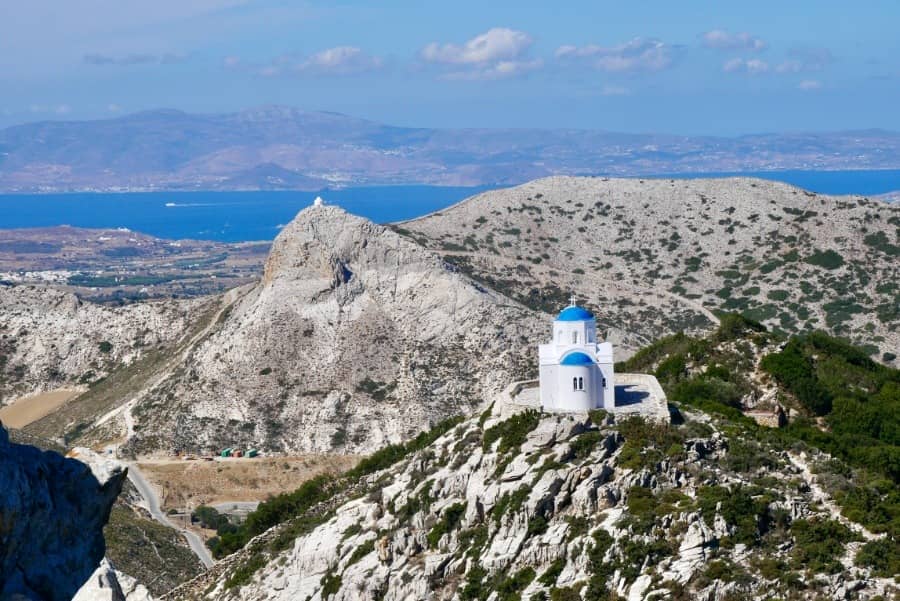
Drive up from Filoti towards Danakos and follow signs to the Agia Marina chapel; there is a rough parking area beside it with room for perhaps a dozen cars. The trail leaves from behind the chapel and is marked with red paint splashes and cairns. It climbs steadily over open rock and low scrub for about 75 minutes to the summit trig point at 1,004 m, with no scrambling and no exposure - but also no shade whatsoever and a loose, stony surface that punishes flat-soled shoes. Come down the same way in about 55 minutes. On a clear morning the summit gives you Paros, Ios, Amorgos, Santorini and occasionally the mountains of Crete on the horizon.
The Zeus cave and the Aria spring
The cave that mythology names as the place Zeus was raised sits on the alternative approach, reached from the Aria spring trailhead lower down. It is a genuine cave - around 115 m deep, with a wide entrance chamber you can walk into without equipment - and archaeologists have found Neolithic and Mycenaean material inside, so people really did use it for millennia. Bring a torch; the light dies quickly past the entrance. Combining the cave with the summit makes a circuit of roughly four hours. If you only want the cave, it is a 40-minute walk from the spring and much the easier option with children.
Four other walks worth the drive
The Flerio kouroi walk near Melanes is fifteen easy minutes through olive groves to two colossal unfinished statues, with a stream and a tiny taverna - the best short walk on the island and fine for all ages. The Alyko cedar forest loop takes about an hour through juniper dunes to the painted abandoned hotel and back. The old marble path from Apeiranthos down to Moutsouna is a serious 3.5-hour descent following the route the emery was carried on, and needs a lift back. And the Routsouna waterfall walk near Keramoti is a short, shaded stroll that actually has running water into early summer - unexpected on a Cycladic island.
When to hike, and when not to
April to early June and mid-September to early November are the hiking seasons on Naxos, when temperatures sit in the low twenties and the island is green. July and August are genuinely hazardous on Zas after about 10:00: the route is entirely unshaded, ground temperatures on the rock exceed air temperature substantially, and mountain rescue on Naxos is a volunteer operation. If you must climb in high summer, be at the trailhead at 07:00 and down by 11:00. Never start Zas in the afternoon in any month - the descent over loose stone in fading light is where the injuries happen.