Chalki - the capital of the Tragea
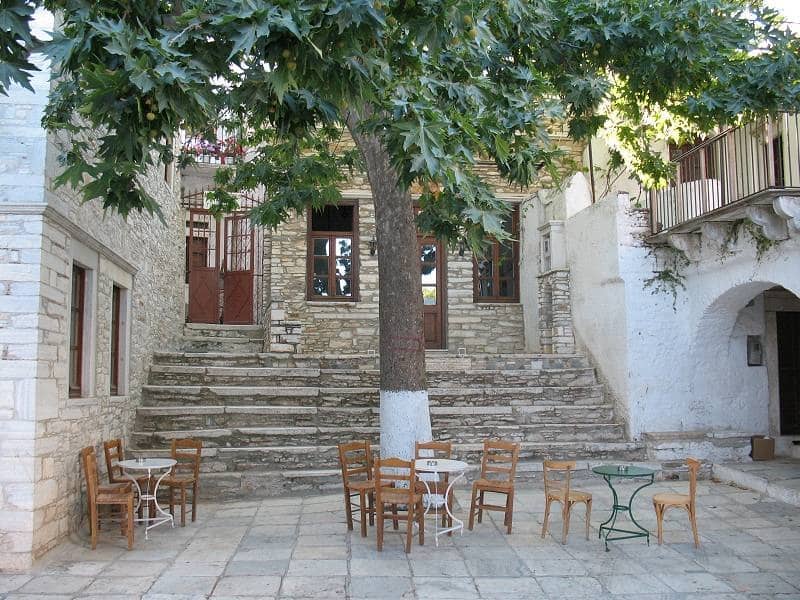
Chalki (often written Halki) was the commercial centre of the island's interior when olive oil and citron were the economy, and its neoclassical merchant houses and Venetian towers still show it. It is small, flat, entirely walkable and the easiest of the villages to enjoy with no plan at all: a square with two cafés under plane trees, a handful of craft shops in restored buildings, and the Vallindras distillery, which has been making kitron - a citrus-leaf liqueur unique to Naxos - in the same copper stills since 1896 and gives free tastings. The Byzantine church of Panagia Protothronos sits on the square with frescoes in five layers spanning six centuries. Twenty-two minutes from Chora on a good road.
Panagia Drosiani - the oldest church you can walk into
Two kilometres beyond Chalki on the road to Moni stands a low, irregular stone church with three apses that looks more like a farm building than a monument. Parts of Panagia Drosiani date to the 6th century, which makes it one of the oldest churches in the Balkans still in continuous use, and the frescoes inside are layered across a millennium - including a rare and unsettling depiction of Christ as a young man rather than the standard bearded Pantocrator. There is usually a caretaker with a key; a small donation is appropriate. Ten minutes and easily the most historically remarkable stop on the loop.
Filoti - the biggest village and the base for Mount Zas
Filoti spreads across the lower slopes of Mount Zas and is the largest village on Naxos after Chora, with around 1,500 residents - which means it functions as a real place: a bakery, a butcher, a pharmacy, several tavernas that are not aimed at visitors. The plateia under the plane trees on a weekday evening, with old men playing tavli and nobody in a hurry, is the most straightforwardly Greek scene on the island and costs the price of a coffee. The Agia Marina trailhead for Mount Zas is a ten-minute drive above the village. The 15 August festival here is one of the biggest in the Cyclades.
Apeiranthos - marble streets and four museums
The climb from Filoti to Apeiranthos is 25 minutes of switchbacks with the Tragea spread out below, and most people stop at least twice for the view. The village itself sits at 600 m, is paved throughout in local marble, and was settled by Cretan refugees in the 17th century who brought a dialect still audible today. Four small museums line the single main street - archaeological, geological, folk art and natural history - which for a village of 700 people says something about how seriously it takes itself. Park at the entrance and walk; the lanes are not driveable. Lunch here, order the goat, and allow longer than you planned.
Koronos, Apollonas and the road north
North of Apeiranthos the road drops into Koronos, a village built vertically down a ravine that made its money from emery mining - the abandoned aerial cableway towers still stand on the hillsides. It is the most atmospheric village on Naxos and the least visited. Beyond it the road runs 20 km down to Apollonas on the north coast, a small fishing village with a pebble beach, a row of fish tavernas and the 10.7 m Kouros lying in the quarry above. The full round trip from Chora is a two-hour drive plus stops, so treat it as a half or full day. The road is paved throughout but narrow and single-lane in places - fine in a small car, unpleasant in the dark.